Showing posts with label Spirit. Show all posts

The Dirty Dozen: Rally Car Showdown

Rally racing is a difficult sport to follow in North America. It doesn't receive nearly the television air time that it deserves which tends to keep it out of the public eye. Still, I've managed to end up with a few rally cars in my collection. Thanks to the popularity of this sport in Europe – home base to most slot car manufacturers' head offices – slot car racers have quite a few interesting subjects to draw upon. Recently, the club at Mini Grid in Toronto started a bi-monthly series for rally cars so I needed to find the most effective tool for racing there. To do this I've reached into my collection a pulled out a cross section of 12 rally cars. I then glued and trued the same formulation of urethane tire to each car, removed the traction magnets, glued in the motors and rear bushings, and then set my best Q time on Mini Grid's Sport track as well as the wood track at Race Haven Hobbies in Brampton. The lap times were averaged between the two tracks and the results and my observations are presented here.

NINCO Porsche 356 – Average 9.596s

Wood: 8.986s / Plastic 10.205s / Mass 65g / Magnetic Downforce 3g

The NINCO Porsche 356 I tested is part of NINCO's classic line. It is powered by NINCO's venerable NC1 motor and while it isn't the fastest car in this review, it is one of the better handling cars. The wheels needed to be glued to their axles prior to testing but ran fairly true for plastic wheels. Owing to the length of the straights on my test tracks the lack of grunt from its NC1 held this car back.

SCX Alpine A110 – Average 9.582s

Wood: 8.973s / Plastic: 10.191s / Mass 67g / Magnetic Downforce 17g

SCX produces a plethora of rally cars. The Alpine A110 is a fairly recent example powered by their unique RX41B motor. This car also has working lights. The wheels on my test car were firmly attached to the axles and reasonable true for plastic wheels. This car also ran out of steam on the long straights of my test tracks reaching top speed after about 2m. If I were looking for more speed the first change I would make would be to replace the 9z stock pinon with a 10z as the stock power plant seems to have plenty of grunt. The RX motors only seem to get faster as they wear in.

Scalextric Austin Mini – Average 9.580s

Wood: 8.656s / Plastic: 10.504s / Mass: 58g / Magnetic Downforce 3g

The Mini suffered the opposite problem of the previous two cars in that it is way overpowered for such a tiny model. This model too has working lights. Scalextric most likely chose the slim can FF050 by reason of packaging considerations. Masive power aside, the wheels on my test car are firmly attached and reasonably round. I had to drive this car with care through the corners but could really wind it out on the straights. This car would benefit from a less powerful motor.

SCX Fiat Abarth 124 – Average 9.420s

Wood: 8.741s / Plastic: 10.099s / Mass: 73g / Magnetic Downforce: 10g

Another reasonably powered SCX rally car with working lights. Again, this model was blessed with round wheels and straight axles. The FIAT is another good handling car in the corners that was lacking in top speed. Increasing the pinion tooth count to 10 would help the lap times drop.

NINCO Renault Clio – Average 9.313s

Wood: 8.863s / Plastic: 9.762s / Mass: 67g / Magnetic Downforce: 3g

It seems to me that NINCO used to put the NC1 in just about every car they made. The Clio is no exception. The wheels on this example needed a drop of glue to keep them on their axles. Other than that this car was good to go. A bit more motor or slightly taller gear might have moved this car up in the standings. Still an easy handling easy to drive car.

Fly Porsche 911 – Average 9.245s

Wood: 9.491s / Plastic: 8.999s / Mass: 81g / Magnetic Downforce: 0g

Fly's model of this ubiquitous rally car is true to the prototype's motor layout in that it is placed behind the rear axle. Out of the box with the traction magnet removed the car is undriveable. Only with the addition of lead up front was this car tamed. Otherwise its nose was happy to bounce right out of the slot under acceleration.

SCX Lancia Stratos – Average 9.187s

Wood: 8.496s / Plastic: 9.877s / Mass: 75g / Magnetic Downforce: 5g

Yet another SCX rally car powered by the RX alphabet soup of motors: this time the RX4. The reasonably true wheels on my example were loose on the axle but this problem was easily fixed with a drop of glue. The Stratos is a small car with a short wheelbase but since it was not overpowered it was an easy driver. Another case where less is more – though I would bump up the pinion tooth count by one if I wanted it to go faster. The nose on this car could use some lowering as well.

Fly Lancia 037 – Average 8.885s

Wood: 8.305s / Plastic: 9.465s / Mass: 80g / Magnetic Downforce: 3g

Fly had done for their rally cars what they had also done for classic LeMans prototypes: offering detailed models in a sidewinder configuration with reasonable FC130 black stripe power. My test car had a spur gear that spun on the axle. I decided to forgo attempting to repair the stock gear and swapped out the defective components for Slot Car Corner Canada bushings and a Slot.it gear and axle. The stock wheels were retained. The Lancia 037 is a good looking good handling car that will only get faster with mild tuning.

Fly Lancia Betamontecarlo – Average 8.696s

Wood: 8.088s / Plastic: 9.304s / Mass: 83g / Magnetic Downforce: 1g

While this Fly car is also a sidewinder, its sidewinder motor pod chassis has more in common with the Fly Classics line than the one piece chassis of the Lancia 037. What this car did have in common with the 037 was a spur gear that spun on the axle. A similar swap to SCC bushings, Slot.it axle, and red Slot.it 36z spur gear made everything right. A fun car to drive once made to run right.

Scalextric Ford Escort – Average 8.674s

Wood: 8.002s / Plastic: 9.326s / Mass: 72g / Magnetic Downforce: 1g

Scalextric brings us another rally car with functioning lights and slim can power. Unfortunately, the crown gear was not up to task in my test car and eventually failed by having a couple sections of the toothed part break away. This is the first time I've experienced a failure like this. While this car ran, it ran great if a tad overpowered.

Fly Renault 5 – Average 8.544s

Wood: 7.835s / Plastic: 9.332s / Mass: 79g / Magnetic Downforce: 2g

The Renault 5 is another Fly sidewinder with black stripe power. It is also another car with a spur gear that spun on the axle – and a problem that was fixed by replacing the defective components with the good stuff from SCC and Slot.it. The stock wheels were retained. Once tuned it was a smooth runner and easy to drive at the limit.

Spirit BMW 1602 – Average 8.244s

Wood: 7.587s / Plastic: 8.900s / Mass: 85g / Magnetic Downforce: 36g

I have to admit that I have a love-hate relationship with Spirit cars. I love some of Spirit's design ideas and the subjects they choose to model. I hate their choice of materials and components. A problem I consistently have with Spirit cars is that any setscrews installed from the factory tend to strip at the first twist of my hex driver. Consequently, the first thing I do when race tuning a Spirit car is replace all their setscrews with Slot.it parts. When I tried to remove the setscrews used to set the front axle height on this car the axle carrier broke right off. I ended up hot-gluing a brass tube onto the BMW's chassis to carry the front axle. Of course, the crown gear's setscrew was stripped. Once the factory's mistakes were fixed, the Spirit BMW turned out to be a barn burner. It was the fastest of all the cars on wood or plastic. The open can FK180 used in this car generates 36g of downforce and sits in an adjustable motor pod. The driver's side mirror was the first casualty of my spirited driving – not something that will be needed given the outright speed of this car once sorted vs. the competition.

Thank-you to Mini Grid and Race Haven Hobbies for the use of the test facilities and to Art Tschinkel for being able to provide me with his superb DArts tires to suit each of the models in this test.

Van LaPointe

Spirit-Early '10 releases

Some early 2010 releases. The new BMW 635's, VW, and Supersport Peugeot 406.

New Spirit 1/43 Porsche!

Spirit will be getting into the 1/43 market in 2010!
This page is from their 2010 catalog, a friend scanned it for me because I don't yet have a catalog. The photo in the catalog is of a real car, not the slot car. More information when I get details from Spirit.

Spirit Supersport Peugeot 406 launch

Spirit is showing photos of their new Peugeot 406 Supersport on their Facebook page.
Here's one photo of the car.

New SuperTires for Spirit Peugeot 406 ST-1800


Super Tires have made a new tire for the Spirit Peugeot 406, see this link. These tires are a very nice fit on the wheels as you can see. They're a nice flat fit across the tire's contact patch.


And, they also fit the Spirit Courage as well! There's a bit of flashing around many of the Spirit Courage wheels I've checked but with a tiny bit of sanding they'd be a great, flat fit as well!

Spirit S3X Motor


Here is what the Spirit website says about the new S3X long can motor which is in their newest cars:

"REF.00104 MOTOR SPIRIT S 3X Faster. Better Braking.
Stronger magnet effect
Specifications: 24.000RPM. / 12v
13,10 g.-cm magnetic force"

Ok, what does this mean? I assume the 13,10 "g.-cm" is an error, and they meant to say the motor produces 13.1 grams of magnetic downforce when placed at Spirit chassis height over Scalextric or other rails. This does not appear to be a torque rating, which would be in units of g-cm (a European decimal point is a comma, and a comma is a decimal point, in English). Several tests of other maker's long can motors with a Magnet Marshal show downforce readings of about 13 grams.

So that leaves us with the claim of 24k at 12 volts for the RPM rating.

Slot Cars Blog tested two sample S3X motors; one had the colorful wrapper proclaiming "S3X", while the other is in the photo above; plain metal finish with a white label, reading "FK-180" and "D/V 15.0", among other things. My hunch was the motor was rated 24k at 15 volts, not 12v as claimed.

Under the light of the tachometer, both motors spun up at 12 volts, no load, to nearly the same RPM: 19,725 RPM for one, and 19,814 RPM for the other. I adjusted the voltage upward to 15 for the faster motor, and measured 26,163 RPM.

By extrapolating the numbers, 19.8k RPM (15v/12v)=24.8k RPM estimated at 15 volts; right on the claimed rating for RPM, but at 15 volts. This agrees with both the label on the motor and approximate performance of the motor.

Therefore, the Spirit S3X is correctly represented as a 24k (up to 26k) motor at 15 volts, and correctly rated at some 19.8k at 12 volts. The torque is unknown. The label on the motor is correct; the info on the Spirit website is incorrect.

Photo tour of the new Spirit Peugeot 406 coupes


A box came today from Kimrey Enterprises and a pair of the new Spirit Peugeot 406 coupe's were inside. Both the British Team livery and the Mardi Gras liveries were there. While I was looking the cars over something struck me, both bodies are very, very thin. They brought to mind some models of ProSlot cars. These cars appear to be purpose built with the racer in mind, the light weight bodies made that clear before I got any further.


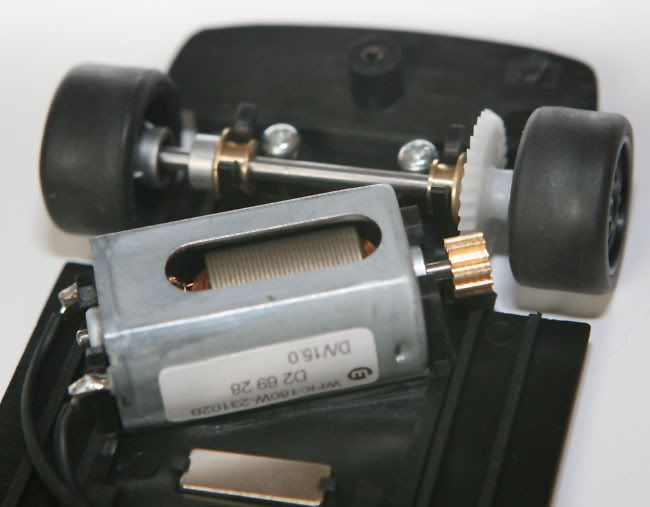
Both cars are mechanically identical, both have the new angle winder pod. And both, oddly come with a motor that appears to be the SX3 long can motor. But this motor doesn't come with a wrapping. And yes you do see a small bar magnet in there. There didn't feel like much of a pull on the Carrera track...

A view of the label on the motor, viewed upside down, with the body off the car.

I must admit to have not seen this model of Peugeot before. The Peugeot marque isn't terribly popular in the US, but even so these car have very pleasing curves to them.


The red car especially is a fine model. The shade of red is very nice and rich, and suits the car well. Both cars paint is well done and totally opaque.


These cars have something going for them that many slot cars don't, it's something that the ProSlot cars had, and these seem to have inherited. There's a certain built-for-the-racer feel to them. They have fairly limited extra details on the body. No photo etched grilles fall off after a few good hits into a wall. No heavy body to have to pull around. They really feel like they're ready to be tuned and heavily raced.

The front axle has a set-screw adjustment. A nice touch for those that like to be able to control the amount of travel of the front axle.

The collar for gear lash is easily adjusted with a standard Slot It wrench.

The pod is adjusted with 3 screws, 1 on the outside of the car on the bottom of the chassis, and 2 screws at the back of the chassis (on these small screws are 2 very small springs). There is a good deal of chassis flex here too, so you could tighten up the screws on the pod and the chassis might flex enough without the pod itself moving much.

The gears feel really nice on both these cars. The crown is a nylon 32 toother and the pinion is a brass 12 toother.


Also like the old (and now out of business) ProSlot, the glass is relatively thin on these cars, and Spirit has chosen to leave out the unneeded piece of glass under the roof, which saves a bit of weight. A nice touch that every company should try and do.

There is a full interior here. It's well detailed but not overly detailed. And it still feels quite light weight.

So how do these cars run? Well, I'm not able to do a full road test at this point, that will come within the next week or so. But on a few initial laps it became clear that the SX3 motor is too much motor for my small wood track, let alone my small plastic Carrera track (Fast & Furious starter set).

I tried the stock tires, which don't work very well on my wood track. I slipped on a pair of SuperTires. While I don't have the exact size needed for the car, it was clear that even the ill fitting tires made this car show its rocket-like side...much like the other recent Spirit cars powered by the SX3 motor. This is a big, powerful motor that begs to be on a big track...wood or plastic. Even though the motor is rated at 24k, the torque on this motor is tremendous!

PartII on these cars in about a week.

Thanks again to Kimrey Enterprises and Spirit for the cars.

DaveK

Spirit LMP's...non-sports editions.


Spirit and Kimrey Enterprises has sent 3 of their latest offerings to Slot Cars Blog, 2 Reynards and 1 of their Dallara's arrived in time for a pre-Christmas review. All are the non-sport versions of the car, but they don't come up short even when compared with the sport cars.


The bright blue Dallara is a striking car visually, but even more so when you get it on the track.

The testing for all these cars was done on the East New York Raceway with power set at 13.8 volts. The stock tires were first tested for a few test laps, they didn't stick well and yielded a 6.8 second lap time around the 61' lap length. Not terribly fast but then Ortmann rubber works best here so the tires were replaced. Within a few laps something was evident...this car is freakin' fast! The laps quickly got faster and faster, and before you know it there was a 5.08 lap appearing on the computer screen...we're talking about some serious speed here. The car whipped around the corners and howled down the 16' straight and was still wanting to speed up at the end of the straight. Tires on this car are everything...find a compound that works on your track and you'll have a winner.

Some testing with a Magnet Marshal yielded the following data. The hard plastic body weighs 22 grams alone, the whole slot car weighs 87 grams. And the magnetic downforce was 116 grams.

One of the reasons for the speed of this car may be due to the fact that much of the car "lives" below the tops of the tires. It's mass is more below the level of the tires than most of the slot cars.

The paint on the car is well done as is the printing, nothing to take away from the overall look of the car or nothing to catch the eye as a blemish.


If you're into a car with a motor pod, then this car is for you. And yes it's a non-sport car technically. Even though it has a pod it does not have set-screw metal wheels. But it does have a sport guide in place which is adjustable with a screw rather than a press in fit.

The wheels on the Dallara have the same rib size as other common wheels and the same rib as the sport wheels. I'd call it a standard size that most would recognize as compatible with the Slot It wheels/tires. A very common size of rib that makes a wide variety of tires useable on this car and the sports versions of Spirit cars as well.

There are differences between the non aren't limited to the obvious lack of aluminum set screw wheels on the standard versions. Both cars have their differences from each other aside from the bodies.

I've cut and pasted the descriptions directly from a recent email with Jose at Spirit:

"Reynard Standard Series: Mounts chassis without pod and the motor SX01 (short box). This model can not mount the long motor S3X because of the complete plastic cockpit. Axles and crown are the same calibrated parts mounted in sport series. The guide is the standard one, without screw. Body is painted and decorated. Rims are plastic and detailed.

Reynard Sport Series: Mounts chassis with interchangeable pod and motor S3X (long box). Also mounts light lexan cockpit and aluminium rims. Body is painted and decorated. The guide is call “Sport” with screw and is injected in a mix of nylon and fiber to reduce the rubbing.

Dallara Standard Series: Mounts chassis with interchangeable pod and motor S3X (long box), complete plastic cockpit, detailed plastic rims, sport guide with screw and painted and decorated body.

Dallara Sport Series: Mounts chassis with interchangeable pod and motor S3X (long box), complete light lexan cockpit, aluminium rims, sport guide with screw and body without decoration and painting."


From this photo you can see the Dallara body is a bit longer than the Reynard.

The Reynard body's are close to the Sport version I recently tested with a few minor details. Some body features like air inlets and obviously livery details and the Lexan vacuum formed interior are missing in the standard (non sport) versions of the cars. I do like that generally the bodies are the same though. It give those that choose to purchase the standard versions a high quality body that doesn't differ in quality or race-worthiness from the sport version, very cool.

Again measurements taken with the Magnet Marshal were taken before racing. The body alone was 26 grams, the whole car was only 78 grams...lighter than the Dallara! And a surprise was that the magnet provided a very sticky 230 grams of downforce.

The wheels are a much larger diameter than the Dallara wheels and the tires aren't interchangeable. Personally I'd like to see the sizes of tires and wheels standardized, but that's just me.

Testing was done first with the stock tires in place. Times with the stock tires were around 6.7 seconds. These tires feel like a different compound than the Dallara tires and the sport version of the Reynard tires. They were very tacky to the touch and in fact maybe gripped a bit too well since a small amount of hop was easily achieved as you rounded the corners. Also the tires are hard to sand so if you're hoping to true them this might take some time.

To change the tires to get faster times, I swapped the rear end of the Dallara into the Reynard, which was an easy snap in that took only a few minutes.

After that it was off to the races. The car was first tested with Slot It S2's, which gave us times around 5.44. And a very smooth ride around the track. With a change to Ortmann rubber times dropped even further and bottomed out at 5.35 seconds.


The chassis on both the Reynards are a flat sheet with no pod (as was noted above) with the SX01 motor, a 24k S-Can type motor. The lower torque of this motor makes this car a great driver and very different than it's cousin the Dallara and these cars I find to be much more "forgiving" to drive than the cars with the SX3 motor.

A few thoughts and I'll wrap this up. Overall these cars provide slotters very fast and race ready cars out of the box. If you're into fiddling with cars, you'll find that these cars really respond well to tuning. With a little work they really turn into monsterously fast cars...and all without benefit of being technically "sports" editions.

Thanks to Spirit and Kimrey Enterprises for providing the cars for review.

DaveK
Publisher, Slot Cars Blog
Get paid To Promote at any Location